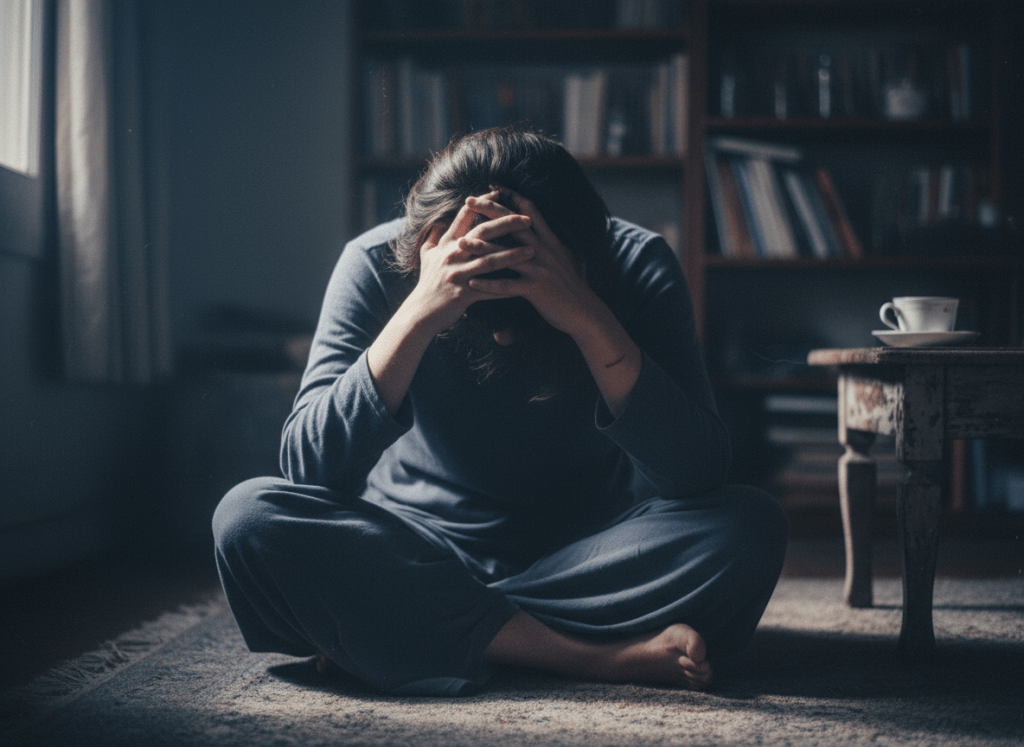
It’s wrong to feel jealousy.
It’s wrong to feel pain.
It’s wrong to feel envy.
It’s wrong to feel attraction.
It’s wrong to feel burnt out.
Most of us grew up with justifications around certain feelings and the demonization (or disapproval) of others. We learnt that certain feelings are not okay, and proceeded to suppress them.
Let’s get some background; here’s some groundwork:
1. Fight, flight, freeze, or fawn mode is triggered when you are under threat. (For clarity purposes, this is what I’m referring to when I use the words ‘stress response’ for the rest of the blog.) The stress response – cortisol, sympathetic arousal, and the activation of the amygdala is universal biology.
Human beings are a unique species where different emotional circumstances can trigger a real threat response in the nervous system. It is not only made to respond to physical threat; it responds whenever something occurs that your personal mind judges as threatening.
For example, if somebody is called a bad person and they experience shame, the body goes into fight or flight. Shame is known to trigger FOF; it’s important to the body not to be seen as a bad person. It’s just inherent to the human condition – not just for people who believe that it is important to be seen as a good person.
2. The Psychology of the Forbidden:
When we label something as forbidden, we actually make it more tempting. In addition, the brain is primed to notice it more – because it is told to stay away.
For example:
If I asked you: how many redheads did you pass today? There is a good chance you will not be able to answer, because you will not know.
However, if I told you tomorrow morning: stay away from all the redheads today; they’re a threat to you – will you notice everyone who has red hair?
Probably, and you would probably be able to give me an estimate of how many redheads you saw that day.
By making a topic taboo, we actually encourage more focusing on it.
Now, I might tell you to notice the redhead and avoid it, but if I want it, the brain won’t just avoid the topic. (Now picture me telling you this about actual people – you want it and will not be able to resist, and how that would groom me to believe I have no choice and I’d be more likely to become a predator – and welcome to the problem of men and women in ultra religious spaces. But anyway, I digress.)
When the brain desires something but it also becomes forbidden, it is viewed as both an attraction and taboo, and people oscillate, retreating and approaching, toward that object. There is no clean avoidance; we are pulled to and repelled from the same thing simultaneously.
So you might what you think is the tried and true method of all humanity (even though they’ve failed): suppression. Maybe after thousands of years of humans failing, you might be the one to succeed.
Bad news: suppression increases the presence of whatever you are trying to suppress. When I am not allowed to be thinking about something, the brain needs to check: am I thinking about it? And / or it needs to spend energy putting it away! (That is why trauma survivors who oftentimes, after working through a trauma, [while it might exhaust you in the short term] they have more energy in the long term, since the brain is not expending energy trying to suppress different matters. It is also why space for memory and executive function might clear up.)
But:
Forbidden makes you notice more. Forbidden eats more energy since it needs to be put away.
Now, the type of forbidden will change how the brain registers things. In the 1970’s, research found that when children were told they cannot have a specific toy and there was a mild threat attached to it, they rated it as less tempting. But when it was a severe threat, it increased desirability after the threat was lifted.
And finally, the dopamine processes are interesting: dopamine neurons get fired more in relation to unpredictable rewards and uncertain outcomes. A reward that comes when you don’t know it’s coming carries much more dopamine in its anticipation than something consistent. (That’s why for addictions, while many try the ‘tell yourself you’ll get it later’ idea, it makes it worse: because the buildup causes more dopamine to fire, building and building, making it harder to resist. A far more productive technique is distracting yourself through regulation.) And then when you engage in what’s forbidden, and all that dopamine is released, it makes it even more addictive = more tempting for next time.
And remember #1 and #3 (trick question, cuz you probably didn’t read #3 yet): the stress response is released, shame is triggered, shame triggers fight or flight…and you have this swimming cocktail of intense emotions.
And a secret about intensity: it’s not only good that’s addictive; intensity is addictive. Bad is addictive too; when there are ups and downs; our brain craves them.
The negative emotional outcome does not become a deterrent; it just becomes a layer of intensity stitched into the loop of emotions that are cycled through when something becomes taboo.
The forbidden is not a simple process of desire on one end and punishment on the other; rather, it is a feedback system where desire and self judgement reinforce each other – making the other stronger – rather than resolving.
Sometimes, especially with ADHD or other neurodivergence, this can cause executive dysfunction.
None of these mechanisms are tied to how good something actually is. They’re about restriction and moral labeling, interacting with motivation, attention and prediction in a way that produces heightened salience.
In order to bypass these loops, which can cause more unwanted behavior, shame, or executive dysfunction, we can take the following route:
Instead of is this good or bad, try asking yourself: is this helpful or unhelpful?
That way, you bypass the brain’s fight or flight / stress response, unlocking your ability to actually avoid what you want to avoid, get done what you want to get done, and not be stuck while a cocktail of chemicals are inhibiting your body.
3. Shame triggers the threat response.
For this topic, let’s make two distinctions.
There is a difference between a bad person and a bad action. Bad actions absolutely do exist. Lying to your business partner, cheating on your wife, taking advantage of the vulnerable: all bad actions. You won’t find me with some polyana approach stating that all behavior is equally okay.
However, the idea of calling someone a bad person ranges into a different category. Guilt, however – the idea that I did something wrong, not that I am wrong – can be a healthy motivator to change (unless we feel guilt in the wrong areas.)
Guilt signals I did something bad.
Shame triggers ‘I am bad.’
When we register ‘bad person,’ that brings up shame in who we are. Research shows that shame tends to trigger fight or flight mode.
Reminder that FOF mode is triggered when the body perceives itself as under threat. Cortisol, the primary stress hormone, is released. Being seen as inherently bad carries a threat to human beings. (It is remarkable that we are creatures to whom emotional characterizations can trigger survival responses.)
So: being averse to being seen as bad, suppressing and judgement coming up when a feeling does, along with the threat response being triggered, creates a whole cocktail of a storm within us when we appraise our feelings as being forbidden.
Now perhaps we have learnt that those feelings make us a bad person – and remember, we, as humans, will avoid things that give us the label as ‘bad.’ It’s a very interesting human instinct to avoid that which places a negative label on us.
Now: when your body has to choose between something that feels like a threat or something that does not feel like a threat, and has no skills to downgrade its threat perception to just information, it will do its best to eliminate the threat: and that can happen by suppression. It’s like knowing that the water you are drinking is poison, and being unable to stop. So the body will naturally choose to take the route that seems to be self preservation.
So you’re left with two choices:
A: Function under fight or flight, and choose the choice you desire despite its threat. This is possible, but puts the body under tremendous stress.
Then there’s B: The body does whatever it can to remove itself from fight or flight mode (often maladaptively.)
So: Forbidden feeling -> Doing something forbidden makes me bad -> The feeling makes me a bad person -> I experience shame -> Fight or flight is activated.
In addition, when something is marked as forbidden, our brain scans for it more. If it triggers a threat response, the scan becomes even stronger, as a higher threat = higher level of scanning, because our brain’s job is to keep us away from threats.
Maybe you don’t experience shame. Maybe it’s not fully forbidden, but only slightly. Maybe you just suppress, for a different reason. With or without the shame, when you can’t feel something, it adds an extra layer to your body in addition to what you are experiencing (that you deemed forbidden). It adds a cocktail of chemicals in your body along with the loop of cortisol, suppression, shame, and
Or perhaps the feelings feel unsafe to feel because shame is triggered. Perhaps they are unsafe to feel because negative labels were tagged onto feelings people in your family. Perhaps they are unsafe to feel because if you felt your feelings, you would be alerted about a situation you are trying to avoid.
The key is to figure out why you cannot feel your feelings, and unravel that from there. I strongly recommend doing this with a competent therapist you connect to.
And guess what the cherry on top is? Even if you managed to suppress it, it’s still there and affecting you.
Now here is the secret third option: what if no feelings were forbidden? What if I can tell you that feelings themselves aren’t the issue, but the meaning we assign to them? What if I can let myself feel fully.
Of course, this becomes possible only if I have the tools to regulate those strong feelings, and I know they won’t influence my actions into unwanted behavior. When strong feelings push us into behavior that is not safe for us, our body characterizes those feelings as unsafe. However, if you have the tools to handle those feelings, they become safe to feel.
There are those who fear that feeling their feelings will lead them to unwanted behavior or feelings controlling them. However, the research demonstrates that allowing them to be felt often calms them, lowering the intensity. It is those who do not feel that are often controlled by their feelings most; much effort and behavior goes into avoiding the feelings. And those ignored feelings? Often they cause the unwanted behavior.
Just like the blue sky is not bad, the green leaves are not bad, and the trees are not bad, feelings are not good or bad. They just are. They exist, and want to be noticed. As Dr. Dan Siegel says, name it to tame it. One prerequisite to safety is to trust in yourself that you will take care of yourself, and part of that is being able to experience all that is going on inside you. (See: internal locus of control.)
The goal is not that all feelings should be used as the primary driver to make all decisions. (In fact, this is often weaponized against abuse victims, encouraging them to ignore their body when it is telling them something. The body often carries wisdom our mind cannot recognize, because for it to recognize it, we have to be aware of it, and our body does not need to be aware of a concept in order to recognize that something is wrong. I can talk you out of thinking you should be confused when I speak, but I can’t talk you out of feeling used: the body doesn’t respond to those words, but to changed behavior. Abuse victims often need the message of ‘don’t listen to your feelings’ when it comes to their guilt that is driving them to do things for an abuser, and the self blame they carry for what happened to them.) All the research shows here is that no matter the decision, the feelings should be allowed to be fully felt and not judged. (Values should drive decisions; not thoughts or feelings.)
Feelings are merely our body communicating to us.
This blog is intended to provide general information and educational content about mental health and well-being. It is not a substitute for professional therapy, medical advice, diagnosis, or treatment, and reading this blog does not create a therapist-client relationship. If you have questions or concerns about your mental or physical health, please seek guidance from a qualified healthcare or mental health professional.
 Enjoying the Content?
Leave a comment